In 2026, I finally did it: I finished Red Dead Redemption 2. Yes, I know, congratulations to me and my extremely patient backlog. I started the game years ago, got swept up in Arthur Morgan's coughing, tragic, horse-riding saga, then bounced off it like a wagon wheel off a rock. Four long years later, I returned, and the epilogue handed me the controller and said: here is John Marston. He is a damn fine shit-shoveller. That is not a euphemism, and it is not an old-timey western saying. It is a mission.
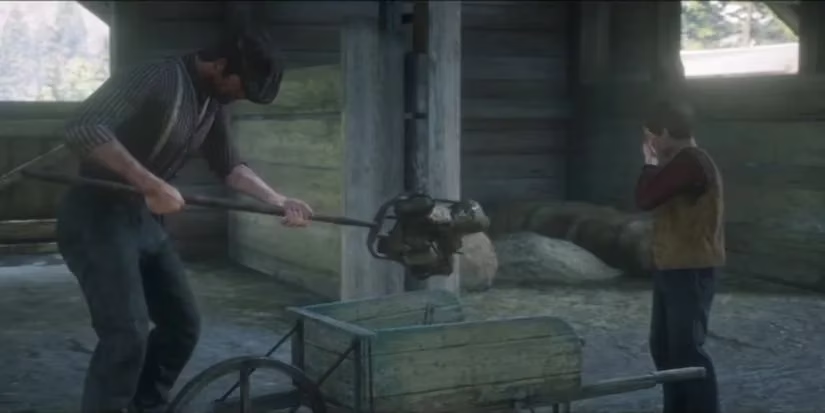
The mission is exactly as glamorous as it sounds. The game marks a shovel on the radar. Not an in-game character, mind you, but the game itself orders me to go pick it up. Then the shovel blip is replaced by several new blips, each one representing a steaming pile of horse manure. I shamble between brown piles and yellow blips until the stable is clean. And because Rockstar cannot let go, I cannot simply drop the shovel. Oh no. I must return it to its original place. Only then does the mission end. It is pastoral grunt work, and honestly, Abigail would be proud.
Now, I actually respect Red Dead 2's tedium-by-design. This is a game that wants you to shelve your typical gamer instincts — do it here, now, quick — and instead be in the moment. Trudging around camp, riding across the prairie, doing farmwork: that is the point. But the poop mission also exposes Rockstar's eternal problem. The studio cannot seem to escape its prescriptive mission style. It directs your every move. It does not trust you to spot your own turds on the ground. It does not trust you to put a shovel down like a normal human being.
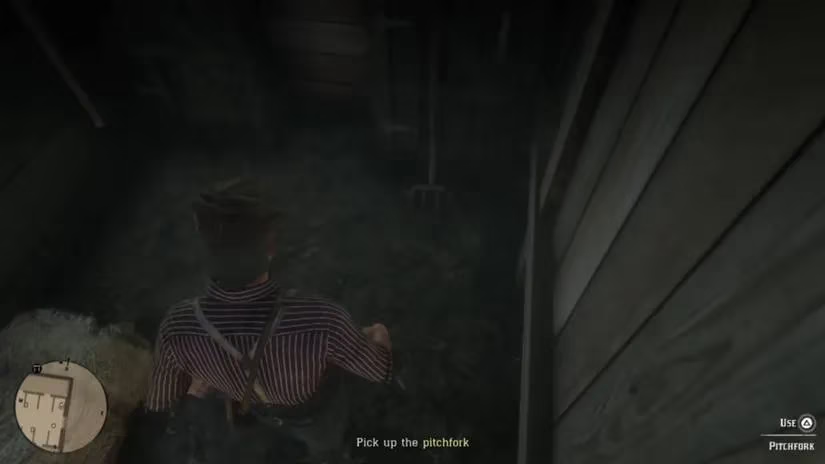
This tiny mission is a microcosm of every Rockstar mission. Micromanaged, guided, and blip-dependent to such a degree that with a little luck you could finish most of the game by staring at the radar in the corner. I am not saying I want to play the whole thing with the screen blacked out, but I am saying that Twitch stream would be the most boring and strangely honest stream in the world.
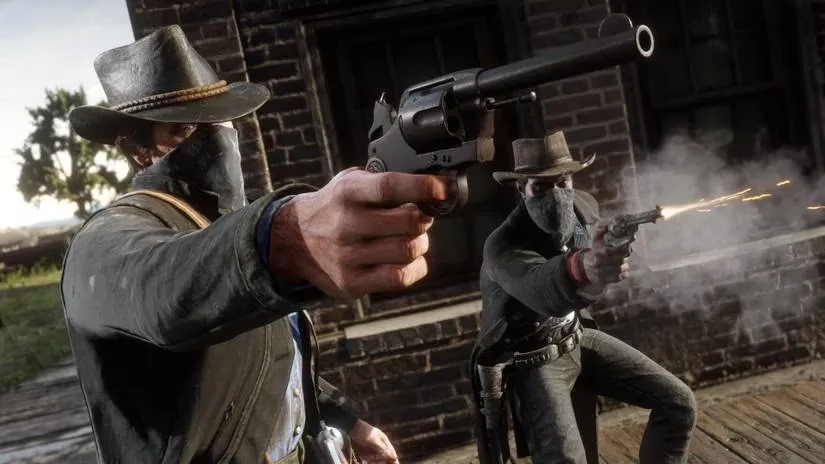
Take one of the climactic missions in Arthur's campaign. It is late in the game, late at night, and judging by Arthur's pained spluttering, late in the life of our doomed protagonist. Alongside Charles, one of the few reliable people in Dutch's disarrayed band, I infiltrate a US army fort to break free the son of the local Native chief. I follow the big blip to the fort, precisely guided by 19th-century satnav. At the front entrance there are guards. In any self-respecting modern game, that is a choice: sneak past, or gun your way in. Not in a Rockstar game. The game orders me to sneak around until I reach the exact secret way in — which is not all that secret, because the game has already directed me straight to it.
What follows is a sequence of stealth kills. Charles gives the order, I kill one guard, he kills the other, and each enemy is marked by that all-powerful blip. If I get spotted, everything fades to black-and-white and I restart. It is the kind of dated, restrictive design I expect from a 2010 Assassin's Creed tailing mission, or a 2001 GTA 3 mission. And the punchline? It all predictably descends into a shootout anyway. By this point I have done the sneak-sneak-shootout rigmarole countless times. There is no diegetic reason to be stealthy. It is just Rockstar's old bad habit of over-directing the experience, which conflicts with the freedom the game offers outside missions.
Here is the Rockstar mission design checklist, as I have experienced it in 2026:
| Step | What I do | What the game thinks |
|---|---|---|
| 1 | Follow the yellow blip | Good job, cowboy |
| 2 | Press the prompted button | You are a genius |
| 3 | Use the exact route | Creativity is forbidden |
| 4 | Get spotted | Fade to black-and-white, try again |
| 5 | Win the inevitable shootout | See? It was a shooting mission all along |
| 6 | Return the prop | Mission complete, you absolute legend |
The irony of Marston's poop-picking is that it is meant to be a tongue-in-cheek wind-down from the high drama of Arthur's finale. But it is really the same mission structure as everything else, except I can justify it because I am a farmhand following orders. Without gunfire, combat music, and red blips trying to kill me, the design is naked. It is outdated, restrictive, and — say it with me — just a bit crap.
In 2026, open-world games have moved on. Players expect systemic freedom, not blip obedience. I still love Red Dead Redemption 2. I love the world, the characters, the horses, the tragic inevitability of it all. But finishing it after four long years made me realize why I kept bouncing off. The game wants me to live in the moment, then it refuses to let me find my own manure. John Marston may be a damn fine shit-shoveller, but Rockstar's mission design could use a new shovel.
This content draws upon Polygon, whose games criticism often examines how narrative ambition can clash with player agency in blockbuster releases. That lens fits Red Dead Redemption 2 especially well: the game’s extraordinary world-building and character drama remain compelling, yet its heavily scripted missions can make even memorable sequences feel constrained, turning moments that should invite improvisation into exercises in following markers and prompts.