As I sit here in 2026, reflecting on the digital landscapes that have shaped my gaming soul, I find my thoughts drifting back to the worlds crafted by Rockstar Games. These are not mere games; they are time capsules, living histories that have journeyed with us across the churning seas of console generations. From the gritty streets of San Andreas to the sweeping plains of the American frontier, these titles have defied the relentless march of technological progress, finding new homes, new screens, and new hearts with each passing year. They whisper a quiet truth: great art is not bound by the hardware of its birth. It adapts, it evolves, and it endures, offering a familiar handhold in an ever-changing digital world.
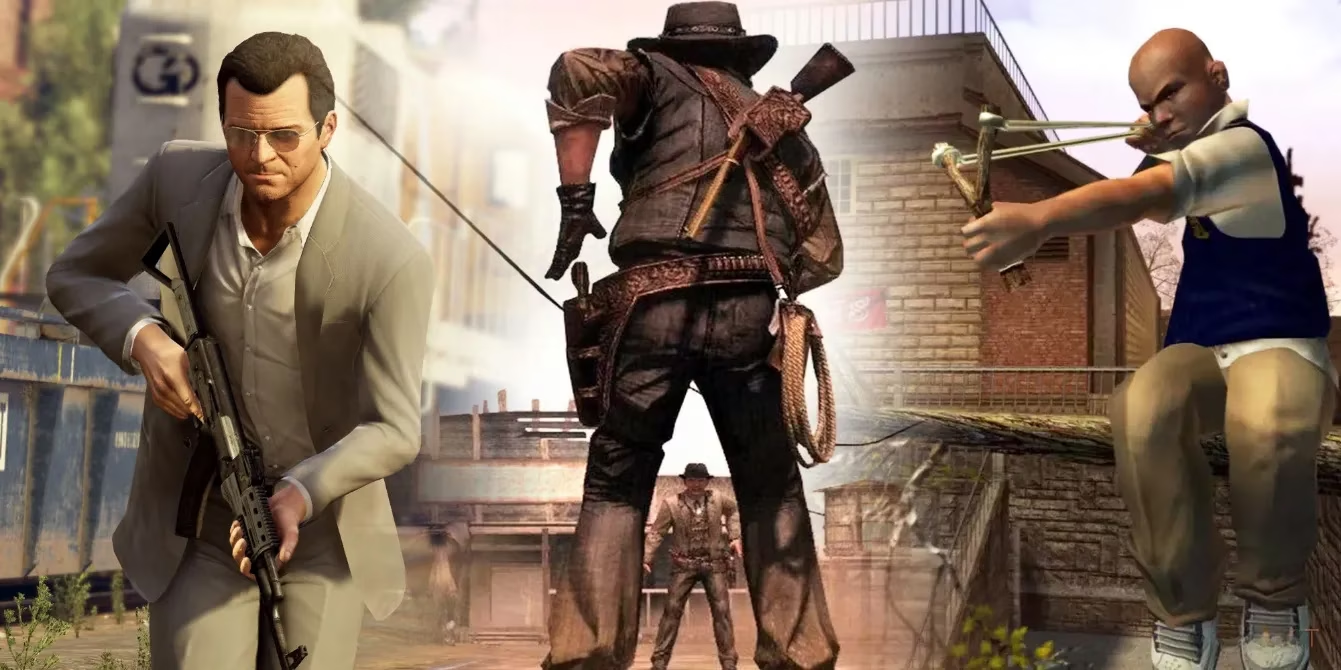
The Enduring Spirit of Bully
My memory first wanders to Bullworth Academy. Ah, Bully. It began its life in 2006, a rebellious spark on the PlayStation 2. I remember the feel of that controller, the pixelated hallways that felt so vast. But Bully was never content to stay in one place. It found a second wind on the Wii, its motion controls adding a new, physical layer to the mischief. Then, it matured on the Xbox 360. And just when I thought its journey was done, Rockstar granted it a Scholarship Edition, a polished chapter for the PlayStation 4. Eight distinct platforms have cradled this story of adolescent angst and adventure. It’s a testament to a singular vision—a coming-of-age tale so poignant that players, myself included, still hold a candle in the dark, hoping for a sequel or a remake to let a new generation experience its unique charm.
Riding Across Time with Red Dead Redemption
Then, the horizon opens up. The original Red Dead Redemption was a sunset I thought I’d only ever witness on my PlayStation 3. John Marston’s quest for redemption was etched in the amber glow of that era. The dream of a sequel felt distant, almost mythical. And then, it arrived—Red Dead Redemption 2—a prequel so profound it redefined the past. But the miracle was the return. To have that original epic, the one that started it all, remastered and placed gently into the palms of players on PlayStation 4, Xbox One, and, most beautifully, the Nintendo Switch… it was a gift. To ride across the plains on a handheld device, to take that solemn story anywhere, was magic. It bridged the gap between Marston and Arthur Morgan, allowing a new wave of outlaws to trace the lineage of this masterpiece. Yet, a quiet hope persists in the PC saloons—a hope for that final, definitive port.
The Colossus: Grand Theft Auto: San Andreas
No reflection on Rockstar’s reach is complete without bowing to the colossus that is Grand Theft Auto: San Andreas. Before Los Santos was reimagined in high definition, there was CJ, Grove Street, and a map that felt like a whole world. Launched in 2004 as a crown jewel of the PS2, its destiny was always greater. It leaped to the Xbox, then found new life on the PlayStation 3 and Xbox 360. But its most daring leap was into our pockets. 👉 Mobile ports transformed it into a constant companion. From a living-room console staple to a time-filler on a commute, San Andreas proved that a truly iconic game environment is omnipresent. It wasn't just ported; it was translated into the language of every gaming era.
| Game | Original Release | Notable Console Generations |
|---|---|---|
| Bully | 2006 (PS2) | PS2, Wii, Xbox 360, PS4 |
| Red Dead Redemption | 2010 (PS3/X360) | PS3, X360, PS4, XB1, Nintendo Switch |
| GTA: San Andreas | 2004 (PS2) | PS2, Xbox, PS3, X360, Mobile, PC |
| L.A. Noire | 2011 (PS3/X360) | PS3, X360, PS4, XB1, Nintendo Switch, PC |
| Grand Theft Auto V | 2013 (PS3/X360) | PS3, X360, PS4, XB1, PS5, XSX/S, PC |
The Noir Gem: L.A. Noire
Some journeys are the most surprising. L.A. Noire, with its rain-slicked 1940s streets and painstakingly captured facial expressions, felt like a delicate, one-off experiment. Its 2011 debut on PlayStation 3 and Xbox 360 was a bold foray into narrative and technology. Who could have predicted its second act? In 2017, it was reborn, crisp and clear, on the PlayStation 4 and Xbox One. And then, the masterstroke: the Nintendo Switch. To hold Los Angeles in my hands, to pore over crime scene details on a train, was unexpectedly perfect. This revival did more than update graphics; it introduced a masterpiece to a new audience, proving that a slow-burn detective story could captivate just as powerfully on a handheld as on a home theater system. Its VR support was merely the final, immersive layer on this multi-generational gift.
The Eternal Phenomenon: Grand Theft Auto V
And then, we arrive at the phenomenon—the game that has become a permanent fixture in the cultural sky. Grand Theft Auto V. When it launched in 2013, we were awestruck by its scale. Little did we know we were witnessing the beginning of an era, not just a game release. Its traversal across three full console generations is unprecedented. From the PS3/Xbox 360, to the PS4/Xbox One, and now to the PS5/Xbox Series X/S, Los Santos has been rebuilt, refined, and re-released. Each iteration brought more players into GTA Online's sprawling, chaotic, living world. It has lived on six distinct consoles, not counting the ever-evolving PC version. As we stand on the precipice of Grand Theft Auto VI, there's a sense that GTA V has been the defining chronicle of an age—a game so vast and infinitely playable that it refused to be left behind. Perhaps its final rest will only come when its successor finally commands the spotlight.
In the end, my journey through these games is a personal one. They are more than entries on a compatibility list. They are bookmarks in the story of my life, each re-release a chance to revisit a memory or see an old friend in a new light. Rockstar, in its wisdom, has not merely preserved these worlds; it has actively shepherded them forward, ensuring that no matter what box sits under our screens, a piece of this grand, digital legacy is always within reach. This is the true magic: not just in creating timeless worlds, but in ensuring the doors to those worlds never truly close. 🎮✨