I still remember the countdown. Not a game timer, not a raid boss enrage, but a legal one: less than 24 hours to comply before Patreon suspended my page. That was July 2022, when Take-Two Interactive dropped a DMCA takedown notice on my R.E.A.L. VR Mods Patreon. The demand? Remove everything related to Red Dead Redemption 2, Grand Theft Auto 5, and Mafia 2. No explanation. No conversation. Just the digital equivalent of a boot on my neck.
I'm Luke Ross. I build VR mods. Not cracks, not pirated copies, not some shady back-alley executable. My mods don't reuse Take-Two's assets. They don't include Rockstar's IP. They require you to own the base game. If anything, they make those games more valuable, because suddenly you're not just playing Red Dead Redemption 2—you're standing inside it, watching the sun bleed over the heartlands through your own eyes. That's not theft. That's love, expressed in code.
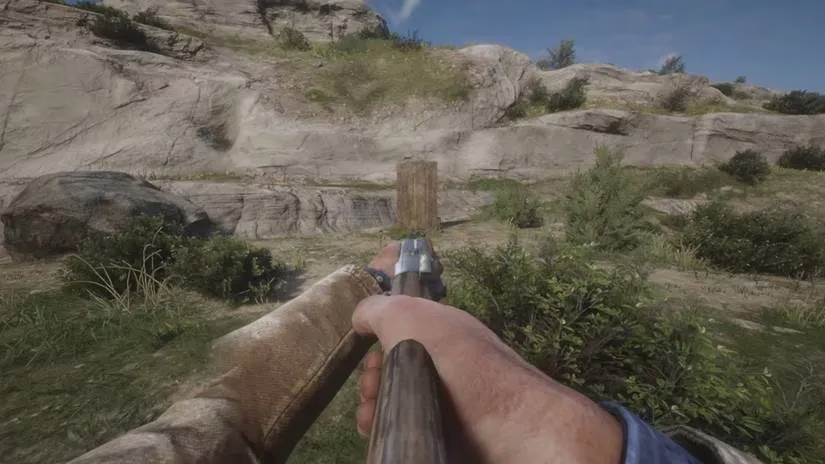
And yet, Take-Two's legal machine didn't care. I told DualShockers at the time that I had less than a day to comply, and I didn't even know what they believed was infringing. That's the part that gets me. Not the corporate muscle—I expect that. It's the silence. The refusal to say, 'Hey, this specific thing crosses a line.' Just a notice, a deadline, and a threat to my income. Around $20,000 a month from Patreon, if you're wondering. That's not pocket change for a modder. It was my livelihood, built one VR conversion at a time.
The weird thing? They sent a copyright notice, not a licensing notice. If this were about monetisation, you'd think they'd frame it differently. But Take-Two has a pattern, and the pattern is pressure. In 2021, they fired off DMCAs at mods like Vice Cry, which just upgraded Vice City's textures, and GTA: Underground, which stitched together maps from GTA 3, Vice City, and San Andreas. All of that happened right before the Grand Theft Auto: Definitive Edition Trilogy launched. And hoo-boy, we all saw how that turned out.
If you want the full history, the GTA Forums thread is a grim little archive. Between 2017 and 2019, Take-Two kept turning the screw. Rockstar apparently convinced them to relax a bit in 2017, and an agreement appeared on Rockstar's website. It was restrictive but reasonable: don't port old GTA content into the newer RAGE engine, don't mess with online modes. Then 2019 happened. The agreement was silently updated. Out went some modder-friendly conditions. In came a new rule: no 'making new games, stories, missions, or maps.' And the closing line? This is not a license. It does not constitute endorsement, approval, or authorization. Take-Two reserves the right to object to any third-party project, or to revise, revoke, and/or withdraw this statement at any time in their own discretion.
Translation: they can do whatever they want. And buddy, they have.
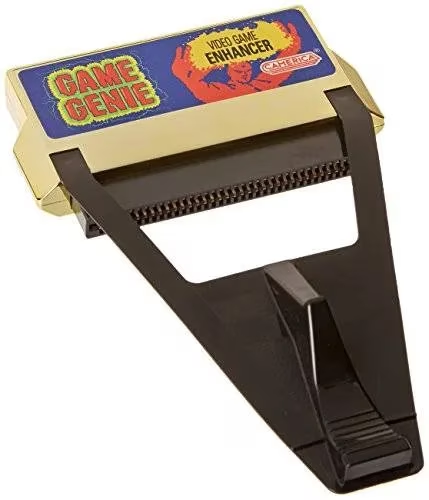
Legally, modders have a strong argument. In Lewis Galoob Toys, Inc. v. Nintendo of America (1992), Nintendo sued over the Game Genie, a cheat cartridge that let players modify SNES games, access hidden files, cut content, and create wild new variations of play. Galoob won. District Judge Fern M Smith wrote that once a consumer has paid Nintendo a fair return, they may experiment with the product and create new variations of play, for personal enjoyment, without creating a derivative work. That sounds a lot like modding, doesn't it? Especially when the product in question was basically a mod cartridge.
But precedent means little when the resources are lopsided. A modder versus a multi-billion-dollar corporation? That's not a fight. That's a footnote. Take-Two can lob DMCA requests like grenades because they know most people can't afford to fight back. The law might be on your side, but the bank account is not. So the notices keep coming, sudden and hard, undercutting projects mid-development and threatening incomes.
Maybe there's a business reason. Rockstar has been working on VR versions of Red Dead Redemption 2 and GTA V. If a free or Patreon-supported VR mod already does the job, that's money not going into Take-Two's hands. Fine. They have the right to monetise their games. But here's the thing: my mods proved you don't need a whole new 'version' to make a game VR. And a little community outreach could have turned a PR disaster into a PR opportunity. Thank the modder. Acknowledge the demand. Give a few months' notice. Send a free copy of the VR game and a goodie bag. Instead, Take-Two showed no gratitude, no outreach, no nothing.
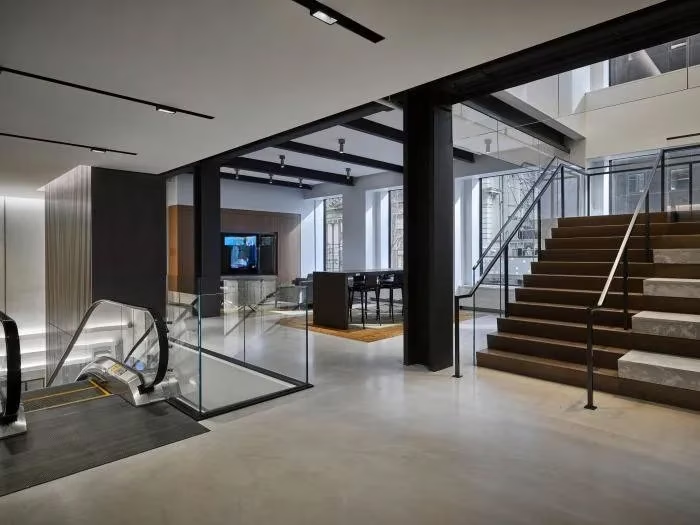
That aloofness is why this stings. Rockstar itself once had words with Take-Two and released that now-modified agreement. Rockstar is no angel, but at least it seems to understand that a healthy mod community adds value. Take-Two often feels several levels removed from the games themselves—like the tower of steel and glass is run by a malevolent AI rather than people who actually play.
I hoped the takedown wouldn't cause a domino effect. I hoped other publishers wouldn't look at Take-Two and think, 'That's how you treat your most passionate fans.' So far, in 2026, I'm still optimistic. My VR mods for The Witcher 3, Cyberpunk 2077, Horizon Zero Dawn, Elden Ring, and Dark Souls are still out there, letting players step inside worlds they love. But the shadow over Red Dead Redemption 2 and GTA V VR remains.
So here's my ask, even now: if you're a publisher watching the modding scene, don't be Take-Two. Don't mistake passion for piracy. Don't send a countdown when you could send a conversation. And if you're a player? Keep modding alive. Keep experimenting. Keep creating new variations of play. Because once the corporations forget why games matter, it's the community that remembers.