Imagine cleaning out your childhood home and stumbling upon a piece of your past that also holds the key to a digital legend. That's exactly what happened to one Red Dead Redemption 2 fan, who discovered an old photograph that felt eerily familiar. It wasn't just a family relic; it was a direct window into the painstakingly crafted world of one of gaming's most celebrated titles, a world that, for all its fictional grandeur, is rooted in very real American soil.
Rockstar Games has always had a bit of a reputation, you know? They're the masters of the digital double-take, the studio that makes you squint at a screen and wonder if you're playing a game or peeking into a parallel universe. While their Grand Theft Auto series famously transplants the essence of cities like New York and Los Angeles into its chaotic playgrounds, their approach to the American frontier in Red Dead Redemption 2 was a different beast altogether. The game's five sprawling states—Ambarino, New Hanover, West Elizabeth, Lemoyne, and New Austin—aren't just random collections of pixels; they're love letters, albeit sometimes gritty and violent ones, to the real geography and history of the United States.
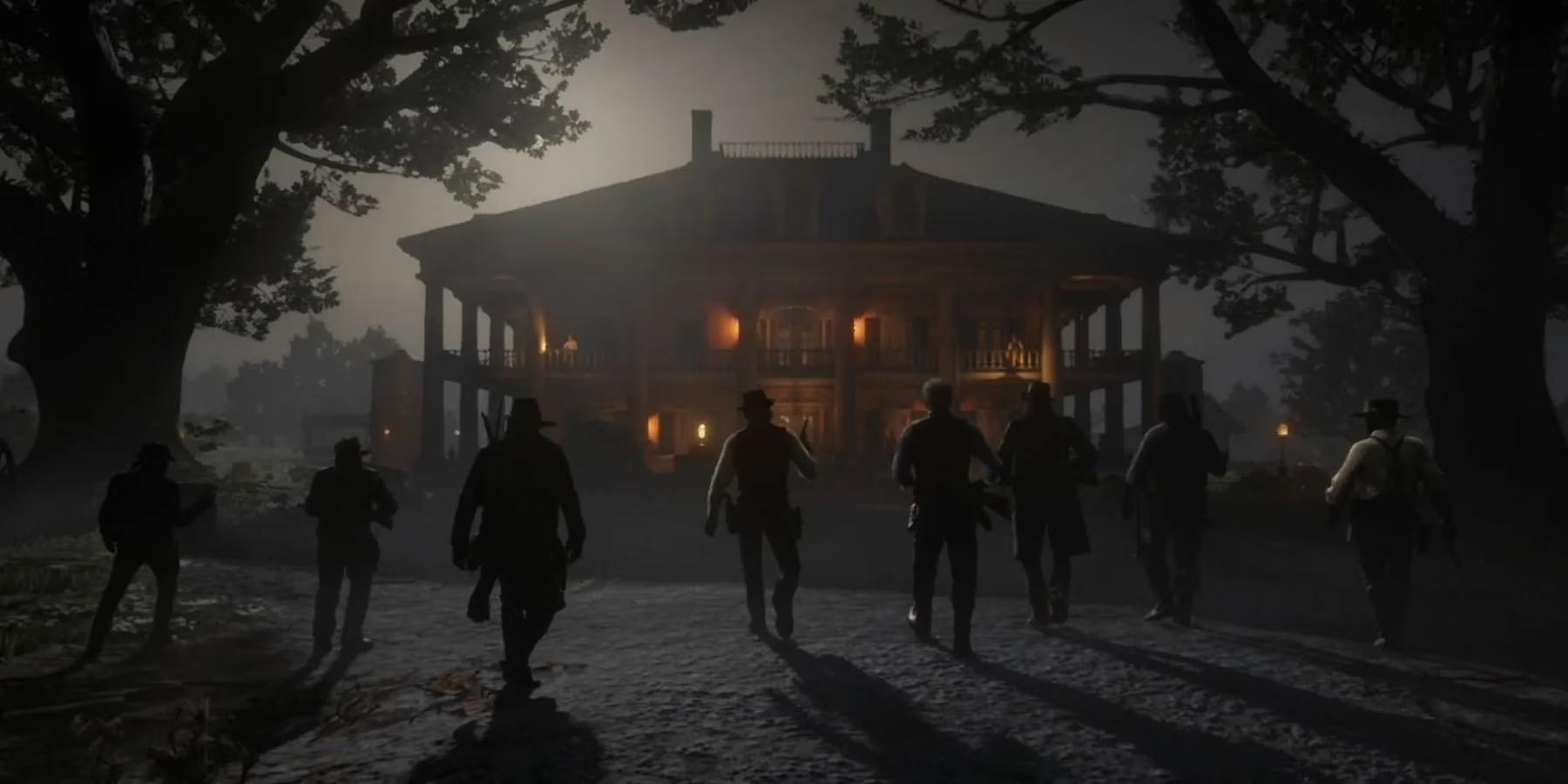
The fan's discovery, shared online, was that uncanny link. The faded photo showed a grand plantation house, its iconic row of towering oak trees forming a majestic alley leading to the front door. To anyone who has spent hours in the humid, tense atmosphere of Lemoyne, the image was an instant flashback. This wasn't just any old plantation; this was the spitting image of Braithwaite Manor, the opulent and deeply troubled home of a family embroiled in the game's complex narrative.
The internet, in its collective wisdom, quickly identified the truth. The photo was of the Oak Alley Plantation in Vacherie, Louisiana. And here's where Rockstar's magic, or perhaps their obsession, really shines through. This isn't a case of "inspired by" in a loose, artistic sense. Oh no. The developers did their homework, and then some. Oak Alley served as one of the primary architectural and atmospheric blueprints for the Braithwaite estate. The level of detail in the recreation is, frankly, bonkers. From the specific layout of the columns to the haunting, moss-draped ambiance of the surrounding trees, Rockstar captured its essence with a precision that blurs the line between documentation and artistry.
| Real World (Oak Alley) | Game World (Braithwaite Manor) | Notable Similarities |
|---|---|---|
| Located in Vacherie, Louisiana | Located in Lemoyne (based on the Deep South) | Greek Revival architecture, iconic oak tree alley. |
| A historic landmark & tourist site | A central location for story missions and conflict. | The imposing frontal facade and symmetrical design. |
| Still standing and preserved. | 😢 Dynamically... alterable by player actions. | The sense of faded grandeur and historical weight. |
It's a fascinating thing, really. Video games often sell us on fantasy—dragons, space travel, superheroes. But sometimes, their greatest power lies in reframing our own reality. They let us walk through history, or a version of it, with a controller in hand. This practice isn't unique to Rockstar. Think about it:
-
Horizon Forbidden West lets us climb the rusted ruins of a futuristic San Francisco.
-
The Last of Us Part II has us navigating the overgrown, haunting streets of Seattle.
-
The Assassin's Creed series has practically become a virtual tourism agency for historical periods.
Developers pour immense resources into recreating these places with acute precision, not just for visual fidelity, but to build a world that feels authentic. That authenticity is what makes the drama at Braithwaite Manor so potent; it feels grounded in a real place with a real, often difficult, history.
Unlike its digital counterpart, which can be left in smoldering ruins after a particularly explosive confrontation, the real Oak Alley Plantation still stands. It's a popular tourist destination and a frequent filming location for movies, TV shows, and music videos. It exists in two planes now: as a physical piece of history in Louisiana and as a digital landmark in one of the most immersive games ever made. Finding that old photo is like finding a secret bridge between those two worlds—a personal memory unexpectedly validated by a global cultural phenomenon. It’s a quiet reminder that the stories we play and the worlds we get lost in sometimes whisper secrets about our own, if we only know where to look. And sometimes, those secrets are waiting in a dusty box at your parents' house, just asking to be found again.